



Garage door insulation is worth considering when an attached garage gets painfully hot, freezing cold, or affects rooms beside or above it. The upgrade slows heat transfer through the door and can reduce outside noise, but it cannot fix leaks through worn seals or poorly insulated shared walls. For most U.S. homeowners keeping an existing sectional steel door, a lightweight rigid-foam kit is the easiest place to start.
| Your situation | Good starting point | What to know |
| Existing sectional steel door | Rigid foam kit | Lightweight, easy to cut, and suitable for many DIY retrofits |
| Hot, sunny climate | Reflective system with an airspace | Helps reduce radiant heat rather than replacing high-R insulation |
| Cold or mixed climate | Higher-R rigid foam | Better suited to slowing conductive heat transfer |
| Heated, cooled, or frequently used garage | Higher-R retrofit or factory-insulated replacement | Comfort gains matter more when the space is regularly occupied |
| Old, damaged, or poorly balanced door | Professional inspection or replacement | Adding material can affect springs, hardware, and opener performance |
| Typical DIY kit budget | Roughly $50–$185 | Current U.S. big-box pricing varies by material and door size |
Direct answer: Garage door insulation slows heat transfer through the largest moving panel in many garages, which can improve comfort and reduce noise. For a sound sectional steel door, lightweight rigid-foam kits are usually the simplest retrofit. Match the material to your climate, keep added weight within manufacturer guidance, seal perimeter gaps, and get spring issues handled by a trained technician.
Key Takeaways
- Insulation makes the strongest case for attached garages, rooms above garages, workshops, gyms, and heated or cooled spaces.
- Rigid foam is a practical DIY choice because it combines useful thermal resistance with relatively low weight.
- Reflective products work differently from foam and need an air space to reduce radiant heat effectively.
- Weatherstripping and air sealing matter because insulation cannot stop heat moving through open perimeter gaps.
- Added weight can affect door balance, springs, tracks, and the opener, so manufacturer limits matter.
- Replacing an aging door may make more sense than retrofitting it when you want a much higher R-value or major structural improvement.
Is Insulating the Door Worth It?
For many attached garages, yes, especially when the space shares walls or a ceiling with conditioned rooms. Slowing heat movement through a large exterior surface can make temperature swings less severe and make workshops or home gyms more usable. Insulation can also dampen some outdoor noise because the added material reduces vibration through a thin metal panel.
The benefit is smaller in a detached garage that is used only for parking and never heated or cooled. In that situation, improving the door may still reduce summer heat or winter chill, but the effect on household energy use is less direct. Homeowners should compare the upgrade against other needs such as sealing gaps, insulating a ceiling beneath a room, or improving the wall shared with the house.
If your garage doubles as a work area, comfort is only one part of the plan. Lighting, safe electrical access, ventilation, and storage can matter as much as temperature control. Housnyst’s garage-workspace lighting guidance offers useful ideas for making that type of space more functional.
Best Garage Door Insulation Materials for U.S. Homes
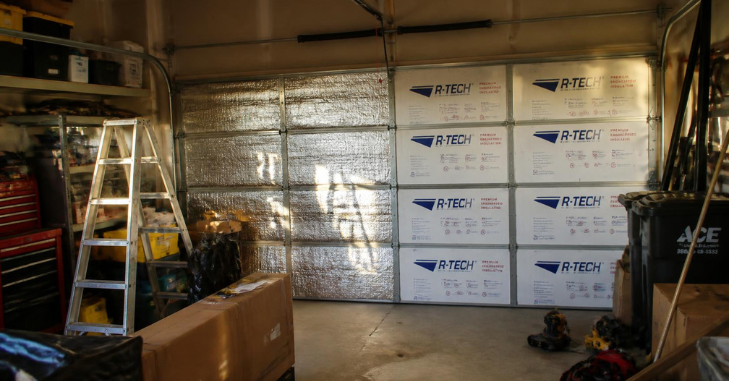
Rigid foam is often the strongest DIY starting point for a sectional metal door. Expanded polystyrene, extruded polystyrene, and polyisocyanurate boards offer different R-values per inch, so thickness and cavity depth matter. Foam is also lighter than many batt products, which can help limit the amount of weight added to the moving assembly.
Garage door insulation Fiberglass kits can provide useful thermal resistance, but they tend to weigh more and need a protective facing to stay neat. Reflective foil systems target radiant heat instead of working like conventional foam, and the U.S. Department of Energy notes that reflective insulation needs an adjacent air space to work properly. Factory-injected polyurethane typically offers higher thermal resistance for a new insulated door, but it is a replacement-door option rather than a simple foam-board retrofit.
| Material | Main advantage | Main limitation | Best fit |
| EPS rigid foam | Affordable and lightweight | Lower R-value per inch than some premium foams | Budget DIY projects |
| XPS or polyiso board | More thermal resistance in limited depth | Costs more than basic EPS | Cold or mixed climates |
| Fiberglass kit | Flexible and widely available | Heavier and vulnerable if exposed to moisture | Compatible doors with manufacturer approval |
| Reflective foil | Reduces radiant heat gain | Needs an airspace and is not a substitute for high-R foam | Hot, sunny regions |
| Factory polyurethane | High thermal performance and added panel stiffness | Requires a new insulated door | Replacement projects |
What R-Value Should You Choose?
R-value measures resistance to heat flow, so a higher number means the insulating layer resists conductive heat transfer more effectively. That number matters most when outdoor and indoor temperatures differ sharply, such as during a Midwest winter or a desert summer. The quality of seals and installation still affects real-world performance, so a high panel rating does not compensate for large gaps around the edges.
There is no single ideal rating for every U.S. garage because climate, door construction, and use vary widely. A basic retrofit may be enough for an unconditioned space in a mild region, while a heated workshop or a room-above-garage setup can justify a higher-R system. If maximum thermal performance is the goal, a factory-insulated replacement often offers more room for insulation than a shallow retrofit cavity.
Hot-climate homeowners should also separate R-value from radiant performance. Reflective materials can help when solar heat is a major concern, but their reflective surface needs an air gap for the intended effect. Foam and reflective products therefore solve related but different heat-transfer problems.
DIY Retrofit vs. an Insulated Replacement Door
A retrofit has a major cost advantage when the existing door is straight, safe, and operating smoothly. Current U.S. listings show common DIY kits ranging from about $54 to $185, while Angi estimates many do-it-yourself installations at roughly $50 to $150 before unusual repairs or hardware work. That makes a retrofit attractive when the goal is better comfort without replacing a functioning system.
A new insulated door is a larger investment, but it can provide better integrated insulation, stronger panel construction, fresh seals, and hardware matched to the door’s weight. Angi’s August 2026 data puts professional insulated replacement projects commonly between about $1,100 and $4,200, with size, material, design, and R-value affecting the final price. Replacement becomes easier to justify when the existing panels are damaged, the system already needs major repairs, or the owner wants substantially higher thermal performance.
| Choose a DIY retrofit when… | Consider replacement when… |
| The existing panels are in good condition. | Panels are damaged, bent, rusted, or deteriorating. |
| You want a lower-cost comfort upgrade | You want substantially higher thermal performance. |
| The door is compatible with an approved lightweight kit. | The current assembly already has balance or hardware problems. |
| You are comfortable measuring and cutting panels. | You want insulation integrated into a new door system. |
How to Insulate an Existing Door in 7 Steps
Start by reading the door and insulation kit instructions before buying materials. Kits differ in weight, thickness, fastening method, and compatible construction, so matching the product to your specific assembly is more important than choosing the thickest panel. Lowe’s specifically cautions that excessive insulation weight can increase wear on the opener and springs.
What you’ll need: a tape measure, straightedge, marker, utility knife or manufacturer-approved cutting tool, gloves, safety glasses, and the specified fasteners or retention clips. Some kits also use double-sided tape or panel retainers supplied by the manufacturer. Keep tools and loose materials clear of tracks, hinges, rollers, cables, and spring components while you work.
- Confirm compatibility. Check the door manufacturer’s instructions and verify that the insulation product is suitable for the model.
- Measure each cavity. Record the width, height, and usable depth of every recessed section rather than assuming all panels match.
- Cut the material. Trim each foam or approved insulation piece so it sits securely without interfering with hinges, rollers, or section joints.
- Fit the panels. Install each piece using the kit’s specified clips, retainers, tape, or friction-fit method.
- Keep moving hardware clear. Openings around hinges, tracks, cables, locks, and reinforcement members must remain unobstructed.
- Inspect perimeter seals. Replace damaged bottom, side, or top weatherstripping when appropriate because open gaps bypass the insulated panel.
- Check operation. Run the system only after confirming that nothing rubs, catches, shifts, or interferes with normal movement.
After installation, pay attention to any change in movement, noise, or opener effort. A system that becomes noticeably harder to operate may no longer be properly balanced for its new weight. Do not compensate by increasing opener force or attempting spring adjustments yourself.
Air Sealing and Added Weight Matter as Much as the Panels
Insulating the panel is only part of controlling heat flow around an attached garage. The Department of Energy recommends sealing construction gaps and wall or ceiling interfaces between unfinished garages and conditioned living space, since air leakage can bypass insulation. Worn perimeter weatherstripping can cause the same problem directly around the moving door.
Added weight deserves equal attention because the door, counterbalance system, tracks, hardware, and opener work together as one assembly. DASMA warns that adding material can change door balance, damage springs, or overwork an opener when the original system was not designed for the extra load. Homeowners should follow the original manufacturer’s instructions and use a trained door technician if the system becomes heavy, jerky, unbalanced, or difficult to move.
Spring work is not a suitable extension of a basic insulation project. Torsion and extension systems store substantial energy, and components under spring tension can cause serious injuries when handled incorrectly. For more perspective on deciding where DIY work stops making financial sense, see Housnyst’s guide to DIY door-installation risks.
Make the Upgrade Fit the Whole Garage
Good garage door insulation starts with the right question: are you trying to moderate heat, improve a workspace, reduce noise, or make an attached part of the house easier to live beside? Once the goal is clear, choose the lightest suitable material, address weather seals, and stay within the door manufacturer’s limits. That approach gives you a useful improvement without creating a mechanical problem elsewhere in the system.
If the existing door is damaged or already operating poorly, get the assembly inspected before adding anything to it. If it is in good condition, a carefully chosen retrofit can be an affordable weekend improvement for many U.S. homes. For more projects related to doors, outdoor systems, and the home envelope, browse Housnyst’s exterior home-improvement guides.
Conclusion
Garage door insulation can be a practical upgrade for U.S. homeowners who want to make an attached garage more comfortable, reduce heat transfer, or create a more usable workshop, gym, or hobby space. The biggest benefits usually come from choosing insulation that fits the existing door, improving weather seals, and addressing air leaks that can otherwise bypass the insulated panels.
For many existing sectional steel doors, lightweight rigid foam provides a straightforward DIY option. However, the highest-R-value material is not automatically the best choice. Climate, available panel depth, garage use, door construction, and added weight all need to be considered. Reflective insulation can be useful for managing radiant heat in sunny climates, but it requires an appropriate air space to work as intended.
Frequently Asked Questions
Is garage door insulation worth it for an attached garage?
It often makes sense when the garage shares a wall or ceiling with conditioned rooms, experiences strong temperature swings, or is used as a workshop or gym. Insulation reduces heat transfer through the panel and may make the space quieter as well. The benefit becomes greater when you pair the upgrade with good perimeter seals and proper air sealing between the garage and living space.
What type of insulation is best for an existing door?
Lightweight rigid foam is a practical choice for many sectional steel doors because it is easy to cut and provides useful thermal resistance without the bulk of heavier materials. The best option still depends on cavity depth, climate, moisture exposure, and what the manufacturer allows. In hot, sunny regions, a properly installed reflective layer may also help manage radiant heat.
Does a higher R-value always mean a better choice?
A higher R-value gives greater resistance to conductive heat flow, but it is not the only measure that determines comfort. Gaps around the edges, panel joints, sun exposure, and air leakage can reduce the benefit of a high-rated product. Choose a rating that fits the climate and use of the space rather than buying by one number alone.
Can insulation damage the opener or springs?
It can create problems if the added material makes the moving assembly heavier than the counterbalance system was designed to handle. DASMA specifically warns that extra weight can affect balance, springs, hardware, and opener performance. Stop using the system and call a trained technician if movement changes after the retrofit.
Should you insulate a detached garage?
It depends on how the building is used. A detached space that holds vehicles and stays unconditioned has less reason for an expensive thermal upgrade, while a workshop, gym, hobby room, or heated garage can benefit much more. Climate, comfort goals, and planned future use should guide that decision.