


Oolong sits in an awkward spot. It is not the delicate green leaf people assume is nearly caffeine-free, and it is not the black tea they blame for a jittery afternoon. The caffeine in oolong tea usually lands between 30 and 70 milligrams per 8-ounce cup. Where your cup falls has more to do with your kettle than with the label on the bag. That spread is wide enough to matter. One cup can be gentler than green tea. Another, brewed hot and long from a bud-heavy leaf, gets close to drip coffee.
Quick answer: A standard 8-ounce cup of brewed oolong carries roughly 30 to 70 milligrams of caffeine, with most cups near 45. That puts it above the average green tea and a little under black tea. Bottled oolong is weaker, at about 25 to 33 milligrams per 8 ounces.Typical caffeine per 8 fluid ounce serving
| Drink | Typical caffeine | What drives the number |
|---|---|---|
| Brewed oolong | 30 to 70 mg | Leaf grade, water temperature, steep time |
| Brewed green tea | 25 to 45 mg | Cooler water and shorter steeps |
| Brewed black tea | 40 to 70 mg | Boiling water and fine cut leaf |
| Drip coffee | 80 to 130 mg | Dose and grind size |
| Bottled oolong, unsweetened | 25 to 33 mg | Brewed light for shelf stability |
| Cold brewed oolong | 15 to 30 mg | Cold water pulls caffeine slowly |
| Decaf oolong | 2 to 5 mg | Carbon dioxide or solvent processing |
Key takeaways
- Most cups land near 45 mg, roughly half a mug of drip coffee.
- Oxidation level is a weak predictor. Bud content and leaf grade tell you more.
- Steep time and water temperature move the number more than the tea you bought.
- The second steep gives about a quarter of the first. The third gives a trace.
- A 30-second rinse does not strip the caffeine, whatever the tea forums claim.
- Bottled oolong is milder per ounce than anything you brew at home.
How much caffeine is in a cup of oolong?
Published figures scatter more than they should. Sellers quote 20 to 60 mg, 25 to 45 mg, 30 to 75 mg. Every one of those is defensible, because each measures a different leaf brewed a different way. Start from the leaf instead. Dry tea runs roughly 2 to 3 percent caffeine by weight. One rounded teaspoon of rolled oolong weighs about a tenth of an ounce, so it holds somewhere near 55 to 85 mg before water touches it. Three minutes of steeping pulls out most of that, though not all.
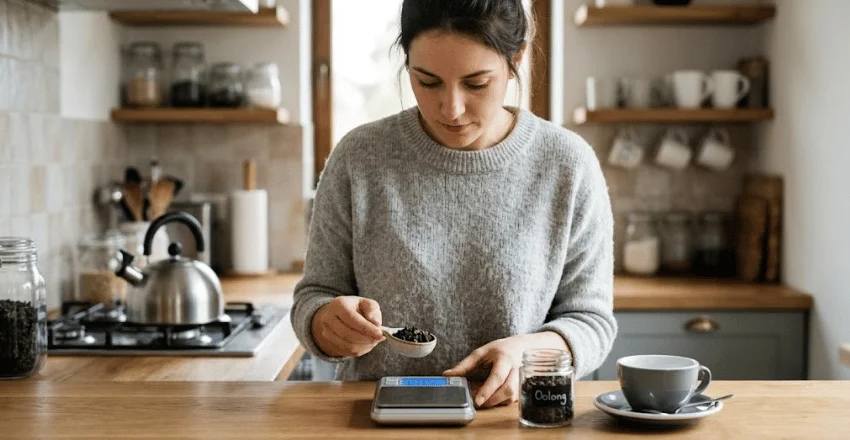
Measuring beats guessing. A small digital scale, or one consistent scoop kept beside the kettle, removes half of that variation on its own. If yours is buried under the spatulas, the zoning method in our guide to organizing kitchen drawers makes room for it.
Oolong tea versus green tea, black tea and coffee
The tidy story says oolong sits between green and black because it is partly oxidized. That story is only half right. You still get a useful reference point out of the comparison.
According to FDA consumer guidance published in 2024, 12 fluid ounces of brewed black tea carries about 71 milligrams of caffeine. Green tea, same serving, holds about 37. Scaled down to an 8-ounce cup, those become roughly 47 and 25 milligrams. Most oolong falls between those two marks. Strong ones pass both. Coffee is a different league. Twelve fluid ounces of regular brewed coffee runs from 113 to 247 milligrams by the same FDA numbers. You would need three or four cups of oolong to match one large drip coffee.
Do different oolong styles land differently?
They do, and not in the order most charts suggest. Common styles and where they usually land per 8-ounce cup
| Style | Rough oxidation | Caffeine per cup | Why it lands there |
|---|---|---|---|
| Tie Guan Yin, green style | 15 to 30% | 30 to 50 mg | Mature rolled leaf, brewed cooler |
| Ali Shan and other high mountain | 15 to 25% | 35 to 55 mg | Tight rolled balls release slowly |
| Dong Ding, roasted | 25 to 40% | 35 to 55 mg | Firing trims a small share |
| Phoenix Dan Cong | 30 to 50% | 35 to 60 mg | Long leaf, usually brewed fast |
| Da Hong Pao and Wuyi rock teas | 40 to 60% | 40 to 70 mg | Boiling water is the norm |
| Oriental Beauty | 60 to 80% | 55 to 80 mg | Bud heavy pluck, the real driver |
Why oxidation is not the lever you think it is
Partial oxidation defines oolong, anywhere from about 10 percent to 80 percent of the way toward black tea. It would be neat if caffeine climbed alongside that number. It does not.
Buds carry more caffeine than mature leaves.
The tea plant concentrates caffeine in its youngest growth, where it works as a natural pesticide. A tea plucked with a high share of buds and first leaves tests higher than one made from older, coarser leaf, whatever happens later in the factory. Bud content beats oxidation level as a predictor, and it always has.
That is why Oriental Beauty, a bud-heavy Taiwanese oolong, often outguns an ordinary black tea.
Roast and age nudge it down.
Heavily roasted oolong loses a little caffeine during firing. Aged oolong loses a little more across the years. Neither drop is dramatic. Dark roasted Dong Ding is not a decaf, and nobody should treat it as one.
What each steep actually gives you
Extraction runs front-loaded, which is the single most useful thing to know about brewing tea.
Rough shares from a standard Western steep, using the same leaf three times:
- First steep, three minutes. Around two-thirds of what the leaf will surrender.
- Second steep. Roughly a quarter of the first cup’s caffeine.
- Third infusion. A trace, often under 10 mg, and easy to drink late.
Gongfu brewing spreads that same total across more, shorter cups. It does not remove any of it. Drink six small cups, and you have drunk the whole leaf.
How to lower the caffeine in oolong tea
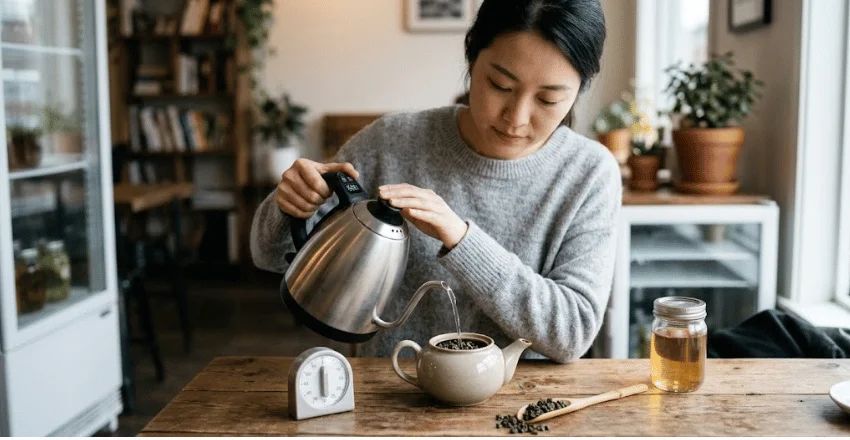
Four moves work. One popular trick does not. Most brewing advice online is written for other kettles, so these numbers are in Fahrenheit.
- Drop the water temperature. Brewing at 185°F instead of a rolling 212°F cuts extraction sharply.
- Shorten the steep. Forty-five seconds pulls far less than four minutes.
- Use whole rolled leaf. Broken dust in a paper bag gives up its caffeine fast.
- Cold brew it. Eight hours in the fridge yields a soft, low-caffeine cup.
- Skip the rinse. A 30-second rinse removes a small fraction, not most, of the caffeine.
The rinse myth survives because it sounds plausible. Caffeine dissolves quickly, so surely a fast pour strips it? Expect a short rinse to take out perhaps a tenth. You lose aroma and keep the buzz.
Bottled oolong is milder than the pot you make
This is where most guides go quiet. Bottlers brew ready-to-drink oolong light and hold it there, so it never reaches the strength of a home steep.
Two examples sold in American supermarkets tell the story. One 16.9 fluid ounce bottle of unsweetened golden oolong lists about 51.5 milligrams. Another widely stocked unsweetened oolong lists 70 milligrams for the same size bottle. Divide either by two, and you get 25 to 35 milligrams per 8-ounce serving.
So the bottle in your bag is the mild option, not the strong one. Keep loose leaf behind a closed door instead of on the counter beside the stove, since heat and light dull the aroma within weeks. If that wall is due a refit anyway, our rundown of dark wood cabinets covers what survives kitchen heat.
How much oolong is too much, and when to stop
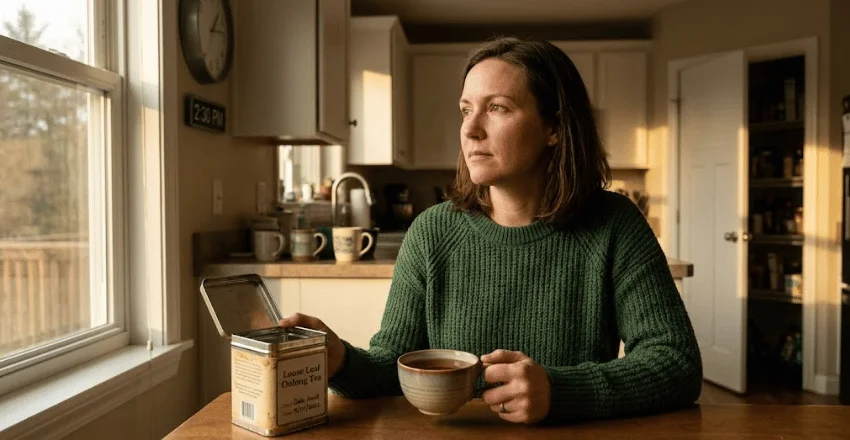
The FDA guidance above puts 400 milligrams a day as the amount not generally linked to negative effects in healthy adults. At 45 milligrams a cup, that is eight or nine cups of oolong before you reach the ceiling. Almost nobody drinks that much tea.
Bedtime is the tighter constraint. Most adults clear only about half a caffeine dose in four to six hours. Your 4 pm cup still has half its caffeine working at 9 pm.
A practical cutoff: stop about eight hours before you want to sleep. Two in the afternoon suits a 10 pm bedtime. Drinking oolong at night is fine if caffeine has never bothered you, and a bad idea if it has.
Pregnancy and heart medication change the math. The FDA tells anyone pregnant or breastfeeding to ask their own provider about limits, and that is the right answer here too. This page describes what sits in the cup, not what suits your body.
One more habit to build. A tin opened last winter has lost aroma, not caffeine, and it is still taking shelf space. Add the tea shelf to your next pantry pass, because our spring cleaning tips work the kitchen in the right order.
Try this with your next pot.
Weigh your leaf, set a timer, and brew at 185°F for 90 seconds. Taste it. Then steep the same leaf again and notice how much lighter the second cup lands. That one experiment tells you more about the caffeine in oolong tea than any chart can.
Frequently asked questions
No. One cup of oolong carries roughly a third to a half of what drip coffee does. Even a heavy-handed steep rarely passes 80 mg.
It can, within about six hours of bedtime. The L-theanine in tea softens the edge of the stimulation, but it does not remove the caffeine.
Yes, though it is rare next to decaf black and green. Expect a few milligrams left rather than none, since no commercial process strips every trace.
Not remove, only reduce. By the third infusion you are usually under 10 mg, which most people never notice.
Look for mature leaf, lightly roasted and rolled, then brewed cool and short. Ali Shan and Tie Guan Yin fit that description far more often than bud-heavy grades do.