

Ask a homeowner how to make a driveway beautiful and they will usually name two options, pavers or stained concrete. There is a third option that costs less than pavers, handles cold climates well, and still looks custom. It is called stamped asphalt, and outside the contractor world almost nobody knows it exists.
What is stamped asphalt?
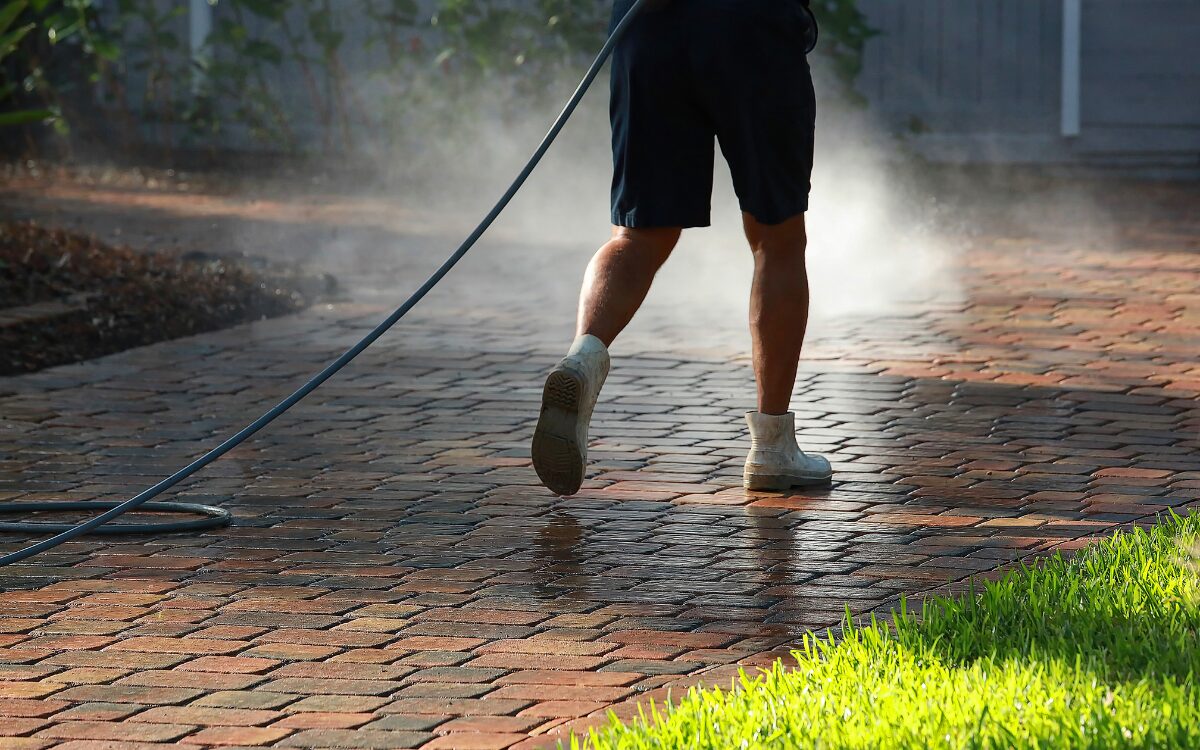
Stamped asphalt is standard hot mix asphalt that is imprinted with a patterned template while still hot, then finished with a colored polymer coating. The result mimics brick, cobblestone, or slate, most often used as a full surface, a decorative border, or an apron where the driveway meets the street. Because the base is ordinary asphalt, the surface behaves like asphalt. It flexes with the ground instead of shifting piece by piece.
How does it compare to pavers?
Pavers are individual units. In climates with hard winters, individual units can heave, settle unevenly, and grow weeds in the joints, and snowplow blades can catch lifted edges. A stamped asphalt surface is continuous, so there are no joints to open up and nothing for a plow to catch. That continuous surface is a practical advantage anywhere, and a decisive one in snow country. For homeowners who love the look of brick or cobblestone but dread the maintenance, stamped asphalt delivers the pattern without the joint by joint upkeep.
Cost follows the same logic. A stamped surface is installed in one continuous operation rather than set unit by unit, which is why it typically comes in below a comparable paver installation.
Where does it make the most sense?
Three placements do most of the work. A stamped apron at the street entrance frames the whole property and is the highest impact use of the technique per square foot. A stamped border along a plain asphalt driveway reads as a fully custom installation at a fraction of the cost of stamping the entire surface. And a full stamped driveway or walkway suits homes where the hardscape is meant to be part of the architecture.
Real estate agents talk about arrival. What a buyer feels in the first ten seconds in front of a home. The driveway is physically the largest object in that first impression, and it is usually the least considered one.
Who installs it?
Stamped asphalt is a specialty. It requires paving experience plus the templates, coatings, and timing knowledge that ordinary paving crews do not carry. That makes it a good filter question when interviewing contractors, because companies that offer it tend to be established operations with deep asphalt experience. In central and southern New Hampshire, for example, Young’s Excavating & Paving of Penacook has been in the paving trade as a family business since 1947 and offers stamped asphalt alongside conventional paving, excavation, and sealcoating across six counties, with free quotes for homeowners weighing the options.
The takeaway
If you want a driveway that looks like it belongs to the house rather than merely leading to it, put stamped asphalt on the shortlist next to pavers before you decide. Get a quote for an apron or border first, since that is where the technique returns the most beauty per dollar, and ask any contractor you interview to show photos of their own stamped installations. The option is less known, but in cold climates it is often the smarter version of the look you already wanted.
About Young’s Excavating & Paving LLC: A fourth generation family paving and excavation company serving Merrimack, Hillsborough, Rockingham, Strafford, Cheshire and Belknap counties in New Hampshire. Young’s Excavating & Paving LLC, 37 Washington Street, Penacook, NH 03303. (603) 231-1598. youngspavingnh.com. Free quotes.