
Here is something property managers often discover only after their portfolios grow. They coordinate a small maintenance job that can take longer than the job itself. A 30-minute service visit may require finding the right professional, discussing the issue, arranging tenant access, confirming an appointment, updating the property owner, tracking completion, and following up afterward.
Multiply that process across 20, 30, or 50 addresses, and maintenance coordination becomes a significant part of the workday. For property managers overseeing residential property care in Seattle, the challenge is not simply keeping individual homes maintained. It is keeping dozens of vendors, tenants, schedules, priorities, and property needs moving without losing visibility. That raises an important question: Can one point of contact make that process easier to manage?
Why Does Property Care Become Harder as Your Portfolio Grows?
The workload changes when maintenance requests start competing for the same people, properties, and time. A plumbing repair may be straightforward on its own, but a turnover can require several services to happen in sequence. Painting may need to follow repairs, cleaning may need to happen after contractors leave, landscaping may need to be completed before photographs or showings, and every appointment may depend on tenant, owner, or property access.
For a manager overseeing several homes, the challenge is therefore not simply the number of work orders. It is keeping those work orders prioritized and sequenced without allowing one delayed appointment to disrupt the rest of the schedule.
At that point, maintenance coordination becomes an operational workflow rather than a collection of individual service calls.
Why Does Managing Residential Property Care Get Complicated?
Seattle’s residential properties can also require different maintenance priorities based on construction, exposure, landscaping, and occupancy. For example, a rental with extensive landscaping may require more frequent seasonal attention than a low-maintenance property, while an older home may warrant closer monitoring of exterior surfaces, drainage, plumbing, or other aging components.
The region’s wet conditions also make routine exterior upkeep important. Gutters, drainage paths, vegetation, exterior surfaces, and areas where moisture can accumulate may require recurring attention rather than waiting for a tenant to report a problem.
For a manager responsible for multiple homes, the challenge is turning those property-specific needs into a consistent maintenance schedule rather than addressing each issue only when it becomes visible.
That operational layer is what makes residential property care in Seattle especially relevant to property management teams.
Is Your Team Managing Properties or Managing Vendors?
The challenge isn’t having multiple specialists. It’s having to manage each specialist separately.
A turnover, for example, might involve a plumber, painter, cleaner, landscaper, and exterior-washing crew. Each provider may have a different availability, arrival window, communication method, and access requirement. The property manager becomes the person responsible for connecting those moving parts.
If the plumbing repair is delayed, the painter may need to move. If painting runs late, cleaning may need to be rescheduled. If the property is vacant, someone still has to make sure each provider can enter and that the work was actually completed.
The operational burden comes from managing the dependencies between vendors, not from the existence of specialized vendors themselves.
What Does One Point of Contact Mean for a Property Manager?
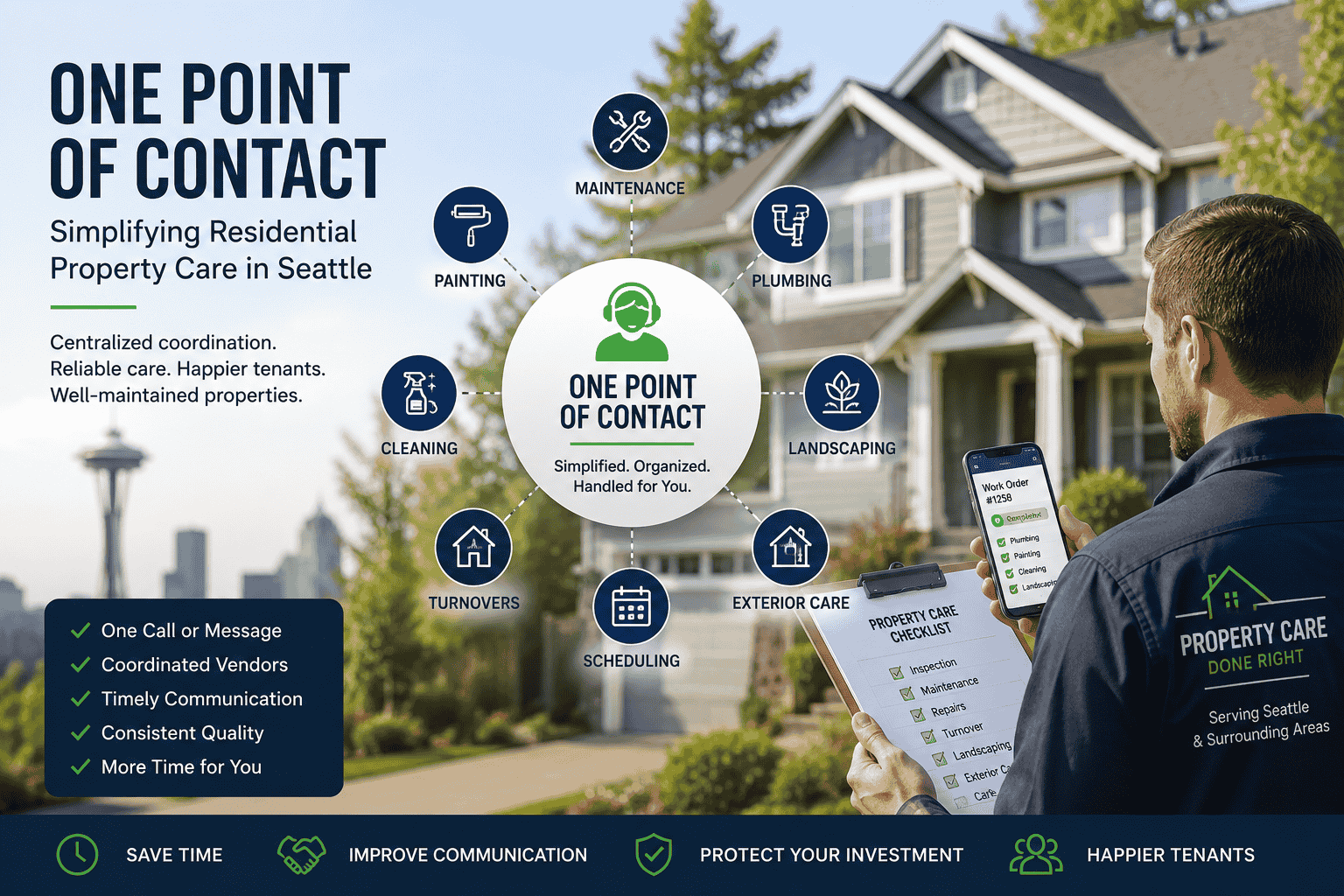
One point of contact is primarily a coordination model, not a replacement for specialized trades.
The property manager may still need a licensed plumber, electrician, painter, cleaner, landscaper, or other specialist. The difference is that the manager does not necessarily have to coordinate each provider independently.
A centralized property-care partner can act as the coordination layer: receiving the request, identifying the appropriate service, arranging access, scheduling the work, communicating changes, confirming completion, and escalating additional concerns to the manager when a decision is required.
In other words, the manager retains control over the property and spending decisions. On the other hand, routine coordination can be handled through a single communication channel.
How Can One Point of Contact Improve Residential Property Care?
Centralized coordination can help property managers address several operational challenges that occur repeatedly across residential portfolios.
1. Reduce Repetitive Communication
A maintenance request often generates several separate conversations before the work even begins. The provider needs the property address and scope of work. The tenant may need an arrival window. The manager may need owner approval. A vacant property may require access instructions. If the appointment changes, those parties may all need another update.
A centralized workflow can consolidate those steps so the property manager isn’t acting as the communication bridge between every participant.
The benefit isn’t fewer messages overall. There are fewer disconnected conversations for the manager to track personally.
2. Coordinate Tenant and Property Access
Access should be treated as part of the work order, not as a separate administrative task.
For an occupied rental, the appointment may depend on the tenant’s availability and any required notice. For a vacant home, the provider may need specific entry instructions or coordination with another contractor already scheduled at the property.
The risk is not simply that a vendor arrives and cannot get inside. A failed access arrangement can push an entire sequence of turnover work off schedule.
A centralized coordinator can build access requirements into the appointment itself and communicate changes before a provider arrives.
3. Keep Turnovers Moving in the Right Order
Turnovers are where maintenance coordination becomes a project-management problem.
Consider a home that has just been vacated. Before it can be photographed and marketed, the property may need plumbing repair, paint touch-ups, cleaning, landscaping, and exterior washing.
These services aren’t interchangeable. Repairs may need to happen before painting. Painting and other dusty work should generally precede final cleaning. Landscaping and exterior work may need to be scheduled around photography or showings.
A centralized coordinator can treat those services as one turnover schedule rather than five independent appointments. That makes it easier to identify dependencies, adjust the sequence when one service is delayed, and give the property manager a single status update.
4. Improve Follow-Through
Completion should be more than a vendor saying the job is finished.
Depending on the service, useful closeout information may include the completion date, work performed, outstanding items, recommended follow-up, photographs, and any condition the property manager should know about.
That information gives the manager a record of what happened without requiring a separate call to every provider. Over time, those records can also reveal recurring issues—for example, repeated drainage concerns, recurring exterior repairs, or maintenance items that continue to generate costs.
That turns maintenance coordination into a source of property information rather than simply an appointment-management exercise.
5. Create Greater Consistency Across the Portfolio
Portfolio consistency is difficult when maintenance is driven entirely by incoming requests.
A responsive tenant may report a minor exterior issue quickly, while a vacant property can go weeks without anyone noticing that landscaping has deteriorated or debris has accumulated. As a result, the property generating the most communication can unintentionally receive the most attention.
A better system separates reactive maintenance from scheduled property care. Each home can be reviewed according to its condition, occupancy, maintenance history, seasonal needs, and upcoming leasing activity.
That creates a more consistent standard of care across the portfolio instead of allowing tenant communication alone to determine which properties receive attention.
Can Centralized Property Care Help Managers Become Less Reactive?
Reactive property management usually begins with a message:
“The sink is leaking.”
“The yard is overgrown.”
“Something looks wrong near the gutter.”
“The unit needs cleaning before the next tenant.”
The property manager responds because the issue has already become noticeable.
A more proactive approach asks a different question:
What will this property likely need before someone has to report it?
For property managers, preventive maintenance becomes more challenging as the number of addresses increases.
You cannot rely on memory to track every property’s exterior condition, landscaping needs, cleaning schedule, turnover history, and recurring maintenance concerns.
This is where experience becomes particularly important.
Professionals who regularly work around residential properties may recognize recurring patterns that deserve attention. They may notice deteriorating exterior finishes, landscaping that needs management, repeated drainage concerns, or other visible changes while completing scheduled work.
Those observations give property managers information.
The manager can then decide whether the issue needs immediate action, future monitoring, owner approval, or inclusion in a preventive maintenance plan.
Proactive residential property care in Seattle is not about trying to prevent every repair. Unexpected problems will always occur.
It is about reducing blind spots across a portfolio.
Who Keeps an Eye on Vacant Properties Between Tenants?
Vacant properties remove one of the most useful sources of maintenance information: the occupant.
No tenant is there to report a slow leak, damaged landscaping, accumulated debris, or a developing exterior problem. That means property managers need another way to maintain visibility between move-out and the next occupancy.
This is particularly relevant during longer vacancies. Routine checks, scheduled exterior services, and documented observations can help distinguish a property that simply needs its regular upkeep from one that requires corrective attention before it is marketed or reoccupied.
For managers overseeing properties across different parts of the Seattle area, having that oversight coordinated can also reduce unnecessary trips solely to verify routine conditions.
Can One Point of Contact Make Owner Communication Easier?
Property managers do not only coordinate with tenants and vendors.
They also answer to property owners.
Owner communication becomes easier when maintenance information arrives in a decision-ready format.
Instead of asking a property manager to reconstruct a job from a text message, contractor call, and invoice, a useful maintenance update can identify what was reported, what was completed, what remains outstanding, and whether additional approval is required.
For example, a turnover update might show that plumbing and painting are complete, cleaning is scheduled for a specific date, and an exterior repair has been identified but is awaiting owner approval.
The manager can then communicate the situation to the owner without spending additional time assembling the information from several sources.
Does Delegating Coordination Mean Losing Control?
Property managers may understandably hesitate to hand over maintenance coordination.
After all, the manager remains responsible for the property-management relationship.
Centralized property care should not remove the manager from important decisions. It should remove unnecessary logistical work from those decisions.
The manager should still know:
- What issue requires attention
- Which service professional will address it
- When work is scheduled
- Whether access has been coordinated
- Whether circumstances changed
- What work was completed
- Whether another service is recommended
- Whether owner approval is needed
Good delegation does not reduce visibility.
It should reduce the number of separate conversations required to maintain that visibility.
When Does a Property Management Portfolio Outgrow the Multi-Vendor Approach?
There is no magic number.
A property manager overseeing a few nearby homes may have no trouble communicating directly with individual service professionals.
The pressure usually increases gradually.
First, the manager notices more time spent making calls.
Then more time goes toward confirming appointments.
Turnovers become harder to sequence. Follow-ups start accumulating. Vendors call while the manager is handling tenant issues. A simple property visit requires traveling across Seattle traffic.
Eventually, maintenance coordination becomes a significant operational responsibility of its own.
Professional residential property care services can make particular sense for property managers who:
- Manage growing residential portfolios
- Coordinate several service categories
- Handle frequent rental turnovers
- Oversee vacant properties
- Manage homes across multiple Seattle neighborhoods
- Spend significant time following up with vendors
- Need more consistency between properties
- Want better visibility without personally overseeing every appointment
The important question is not whether the property manager can coordinate everything.
Most experienced managers can.
The better question is whether personally coordinating every service appointment remains the best use of their expertise and time.
What Should Property Managers Look for in a Property Care Partner?
A long list of maintenance services is less important than the system used to coordinate them.
Before choosing a property-care partner, property managers should ask:
How are vendors selected and qualified?
Who communicates with tenants?
How are access arrangements documented?
What work can proceed without manager approval?
How are unexpected costs escalated?
What information is provided when a job is completed?
Are photographs or service notes available where appropriate?
How are emergencies handled?
How are recurring maintenance issues tracked?
What happens when a vendor misses an appointment?
These questions reveal whether the provider is genuinely reducing administrative work or simply becoming another vendor the manager has to manage.
Could One Contact Give Property Managers More Time to Actually Manage?
Property managers bring value through judgment, relationships, organization, and oversight.
Their highest-value work includes communicating with owners, supporting tenants, overseeing leasing activity, evaluating property needs, managing risk, and making informed decisions about the properties under their care.
Calling three vendors to confirm arrival times does not necessarily require that expertise.
Neither does repeatedly arranging access, checking whether routine work happened, or coordinating the order of cleaning, painting, landscaping, and exterior services during a turnover.
That is the real opportunity behind centralized property care.
One point of contact cannot eliminate maintenance problems. It cannot prevent a contractor from occasionally rescheduling or stop an unexpected repair from appearing.
What it can do is create a more organized path between “this property needs attention” and “the work has been handled.”
For a Seattle property manager overseeing an expanding portfolio, that difference can matter.
Simplify the Work Behind Every Property
If your team spends more time coordinating cleaners, landscapers, painters, maintenance professionals, schedules, tenant access, and follow-ups as your portfolio grows, consider whether the process itself needs to change.
Professional residential property care services can provide a more centralized approach to routine upkeep, turnovers, exterior care, vendor coordination, and ongoing property attention. Explore your options for coordinated property care and see whether one reliable point of contact can help your team spend less time managing maintenance logistics and more time managing the properties, owners, and tenants that depend on you.