

Outdoor PEX pipe is specifically engineered to keep hot water at the right temperature as it travels underground from your outdoor boiler to your home, barn, or garage, even when temperatures outside drop well below freezing.
If you run an outdoor boiler system, you already know how satisfying it is to have consistent, radiant heat throughout the coldest months of the year. But what most people do not think about is what happens underground, between the boiler and the building. That stretch of pipe is where a lot of things can go wrong if you are using the wrong material. And that is exactly why outdoor PEX pipe exists.
Let me walk you through how it works, why it matters, and what to look for when choosing the right pipe for your setup.
What Is Outdoor PEX Pipe, Exactly?
Outdoor PEX pipe is not your standard plumbing PEX. It is a specialized underground pipe system designed to carry heated water between your outdoor wood furnace and whatever structure you are heating. The pipe itself is made from cross-linked polyethylene (PEX), which is already known for being flexible, durable, and resistant to cracking.
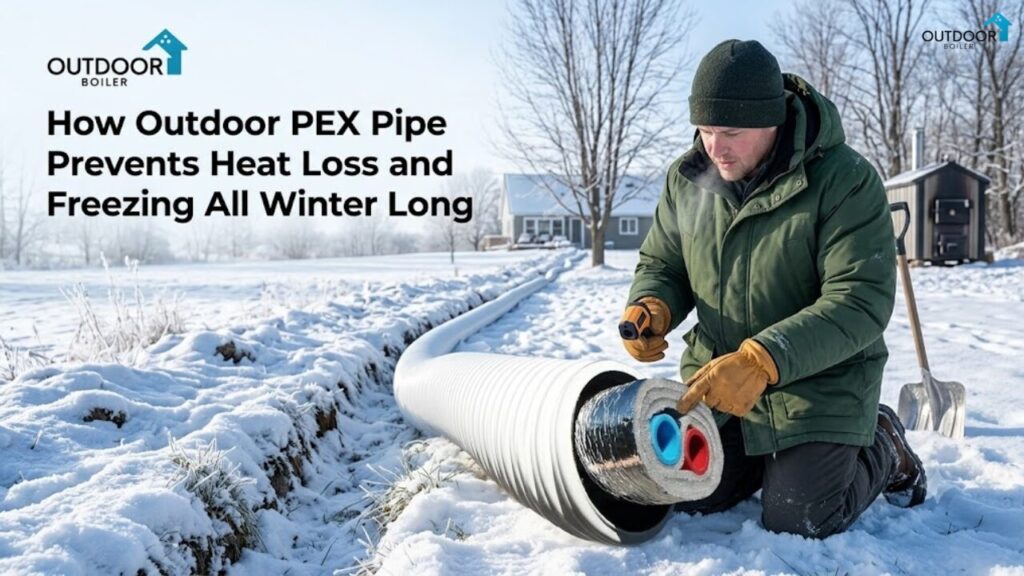
What makes outdoor PEX different is the added insulation layer wrapped around the PEX tubing, all sealed inside a waterproof outer jacket. This construction is what gives it the ability to resist heat loss and hold up in freezing ground temperatures.
Think of it like a thermos for your hot water line. The insulation keeps the heat in, and the waterproof casing keeps moisture and ground pressure out.
How Does It Actually Prevent Heat Loss?
Heat naturally wants to move from warm areas to cold areas. When hot water flows through a pipe that is buried in cold ground during January, physics is constantly working against you. Without proper insulation, the water arriving at your building can be significantly cooler than when it left the boiler. That means your system has to work harder, burn more fuel, and still struggle to keep up.
Outdoor PEX pipe solves this through a few layers working together:
The PEX tubing itself has naturally low thermal conductivity compared to metal pipes like copper or steel. It does not conduct heat away as aggressively, which is already a head start.
The foam insulation layer wrapped around the PEX is the real workhorse. It creates a thermal barrier that dramatically slows down heat transfer to the surrounding soil. According to the U.S. Department of Energy, proper insulation can reduce heat loss by up to 45 percent in pipe systems, which translates directly into lower fuel consumption and more consistent heat delivery.
The outer jacket protects everything from ground moisture, soil pressure, and physical damage during installation or soil movement. Without this layer, even the best insulation degrades over time.
The result is that the water arriving at your building is nearly as hot as when it left your outdoor boiler, even after traveling 50, 100, or 200 feet underground.
Why Does Freezing Become a Real Risk Without the Right Pipe?
You might be thinking, “The water is always moving, so how could it freeze?” And you are mostly right. As long as your outdoor boiler system is running and circulating water 24 hours a day, a buried pipe is generally safe from freezing. However, there are situations where freezing becomes a genuine threat:
Power outages. If your circulation pump loses power, water stops moving. In very cold weather, uninsulated or poorly insulated lines can begin to freeze within hours.
System shutdowns. If you are away from the property, or if the boiler runs out of fuel unexpectedly, that stagnant water in an uninsulated line is at risk.
Shallow burial. Most installers recommend burying outdoor PEX at least two feet deep, where ground temperatures stay well above freezing even in harsh winters. But if a line runs shallower in certain spots, proper insulation becomes even more critical.
The thick foam insulation in outdoor PEX pipe acts as a buffer. It slows down heat loss so dramatically that even during short periods of no circulation, the water inside retains enough warmth to stay liquid long enough for you to address the issue.
What Is the Difference Between O2 Barrier and Non-O2 Barrier Outdoor PEX?
This is one of the most common questions people ask when shopping for underground insulated PEX pipe, and it is a good one to understand before you buy.
O2 Barrier PEX has an additional oxygen barrier layer built into the pipe wall. This is important for closed-loop hydronic heating systems because oxygen that enters the water can cause corrosion in metal components like pumps, heat exchangers, and boiler parts. If your system uses a boiler with cast iron or steel components, O2 barrier PEX is usually the smarter choice for long-term system health.
Non-O2 Barrier PEX does not have that extra layer, which makes it slightly more flexible and a little less expensive. It works perfectly well in systems where the heating loop is fully isolated from oxygen-sensitive components.
A good rule of thumb: if your system has any metal parts in the loop, go with an O2 barrier. When in doubt, ask your boiler manufacturer or installation professional which one your specific setup calls for.
How Deep Should Outdoor PEX Be Buried?
Here is why. Frost depth varies significantly by region. In warmer southern climates, the ground may only freeze a few inches deep. In northern states and Canada, frost can penetrate two to four feet or more in the worst winters. When outdoor PEX is buried below the frost line, the surrounding soil stays at a relatively stable temperature of around 45 to 55 degrees Fahrenheit year-round, even when air temps are far below zero.
That stable ground temperature, combined with the pipe’s foam insulation, creates a very reliable environment for your water lines. The pipe does not have to fight nearly as hard to maintain its temperature.
For areas where you cannot bury as deep due to rocks, existing utilities, or other obstacles, using a higher-grade insulated PEX with thicker foam becomes even more important.
Does Outdoor PEX Pipe Last a Long Time?
Absolutely. One of the major reasons outdoor PEX has become the industry standard for outdoor boiler installations is its longevity. Quality insulated PEX pipe is designed to last for decades when it is properly installed, and the system water is correctly treated.
PEX tubing itself is highly resistant to mineral buildup and corrosion, which are two of the main reasons traditional metal pipes fail over time. The outer jacket resists soil acidity, moisture intrusion, and root pressure. When you factor in the lower maintenance demands compared to metal pipe systems, outdoor PEX delivers strong long-term value.
The key to maximizing that lifespan is proper water treatment in your boiler system. Untreated water leads to internal corrosion and scaling, which shortens the life of every component in your loop, including the pipe. This is something worth paying attention to from day one.
Can Outdoor PEX Be Used for Other Applications Besides Heating a Home?
Yes, and this is where outdoor boiler systems really shine in terms of versatility. Outdoor PEX is used regularly for:
Heating garages and workshops. Running a line to a detached garage is one of the most popular applications. A unit heater connected to the loop can keep a large space warm without the need for a separate heating system.
Heating barns and agricultural buildings. Livestock buildings benefit enormously from consistent, low-cost radiant heat during winter months.
Heating domestic hot water. With a properly installed heat exchanger, your outdoor boiler can supply preheated water to your home’s domestic hot water system, significantly reducing your water heating costs.
Heating pools and hot tubs. Extending heat to a pool or spa is another common use, especially for those who want to extend their swimming season without paying enormous energy bills.
Radiant floor heating. Some homeowners connect their outdoor boiler to a radiant floor system for whole-home heating that is incredibly even and comfortable.
In every one of these applications, the outdoor PEX underground line is the critical link. The better that line performs, the more efficiently heat reaches where it is needed.
Frequently Asked Questions
Most outdoor PEX pipe uses compression or barb-style fittings that connect to the supply and return ports on your boiler. The specific fitting size will depend on your pipe diameter, most commonly 1 inch or 1.25 inches. Always follow the manufacturer’s guidelines and use the correct fitting type for PEX (not copper or CPVC fittings, which are not compatible).
Many homeowners successfully install their own outdoor PEX lines, especially for shorter runs. The pipe is flexible enough to coil around obstacles, and the fittings are manageable without specialized tools. That said, longer runs or more complex installations benefit from professional guidance, especially when it comes to proper burial depth and system pressurization.
There is no hard limit, but longer runs do require larger pipe diameters to maintain adequate flow and minimize pressure drop. A 1-inch pipe works well for most runs under 150 feet. For longer distances, moving up to 1.25-inch pipe helps maintain efficiency. It is always a good idea to map your run length before selecting pipe size.
If the pipe is too shallow, it becomes more vulnerable to frost and temperature swings. Shallow burial can also mean the pipe is at risk of damage from surface activities like digging or heavy equipment. Installing at the correct depth protects both the pipe and the system’s performance.
Yes, significantly. Standard plumbing PEX is not designed for outdoor underground use and does not have the insulation or protective outer jacket that outdoor PEX includes. Using standard PEX underground for an outdoor boiler system would result in major heat loss and potential freezing risk. Always use pipe that is specifically rated and designed for outdoor underground boiler applications.
The most common sign is that your boiler is working harder than usual, running longer cycles, or that the heat output in your building feels inconsistent. If the water temperature at the supply side of your boiler is significantly higher than what is arriving at the building’s heat exchanger, heat loss in the underground line may be the culprit.
The pipe itself does not require routine maintenance. However, the system as a whole benefits from annual water testing and proper chemical treatment to prevent internal corrosion and scale buildup. Inspecting exposed connections and fittings annually is also a smart habit.
Conclusion
Getting your outdoor boiler system right starts with the underground line. The outdoor PEX pipe connecting your boiler to your building is not just a convenience; it is the backbone of your entire heating system. Choosing properly insulated, high-quality pipe means more consistent heat, lower fuel costs, and a system that holds up for decades without constant attention.
Whether you are putting in a brand-new installation or replacing an aging line that has been giving you trouble, understanding how outdoor PEX pipe works gives you the confidence to make the right choices for your setup.
If you have questions about which pipe is right for your system, what size you need, or how to plan your installation, our team at Outdoor Boiler is ready to help. You can reach us directly through the contact page and get real answers from people who use this equipment themselves. Do not guess when you can get expert guidance for free.