

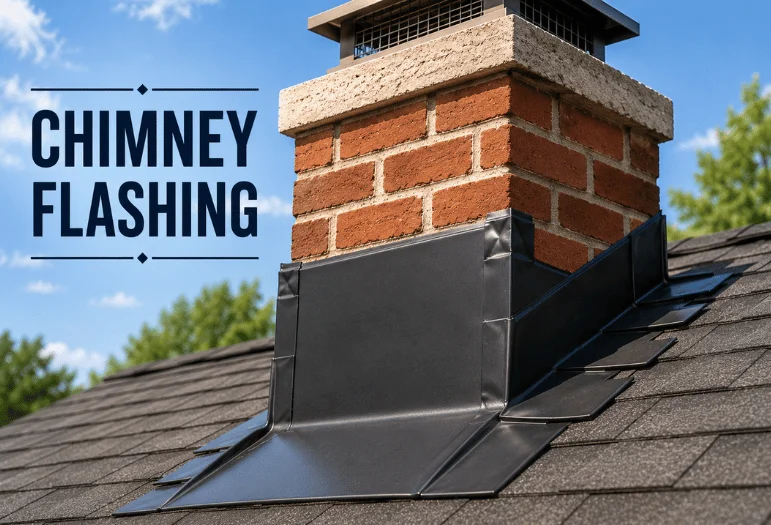
A brown ring on the bedroom ceiling below the fireplace almost always traces back to one place. Chimney flashing, the metalwork sealing the joint where the roof meets the masonry, generates more leak calls than any other roof detail. It fails slowly, over years, and the first thing most people notice is the damage indoors. This guide covers what the assembly is, why it goes, what a fix costs in 2026, and when to hand the job to a roofer. Also worth reading: What a Professional Chimney Sweep Removes.
Short answer: chimney flashing is the metal that bridges the joint between your roof surface and the brickwork. It works in two layers, one woven into the shingles and one let into the mortar above it. Water gets in when that overlap opens up, corrodes, or was only ever caulked in the first place.
The four parts, at a glance
| Part | Where it sits | What it does | How it usually fails |
| Base or apron flashing | Across the downhill face | Carries water off the front of the stack onto the shingles | Rusts through at the bend, nail heads back out |
| Step flashing | Woven into every shingle course up both sides | Moves water down the slope one course at a time | Swapped for a single long bent strip that cannot flex |
| Counter flashing | Cut 1 to 1.5 inches into a mortar joint above the step pieces | Caps the top edge so nothing runs behind the metal | Caulked flat to the brick face instead of let into a reglet |
| Cricket or saddle | Uphill side, on any stack wider than 30 inches | Splits water, ice and debris around the back | Left out completely on wide stacks |
Key takeaways
- Two layers, not one. Step pieces belong to the roof, counter pieces belong to the masonry, and they overlap without being fastened to each other.
- Caulk is a finishing touch, never the seal. A bead of sealant doing structural work is a repair with a three-year clock on it.
- Most repairs land between $400 and $800 in 2026. Full replacement with a saddle runs $800 to $1,500.
- Match the metal to the job. Aluminum against copper or fresh mortar corrodes.
- If the shingles have under five years left, replace the metal with the roof, not before.
What chimney flashing is, part by part
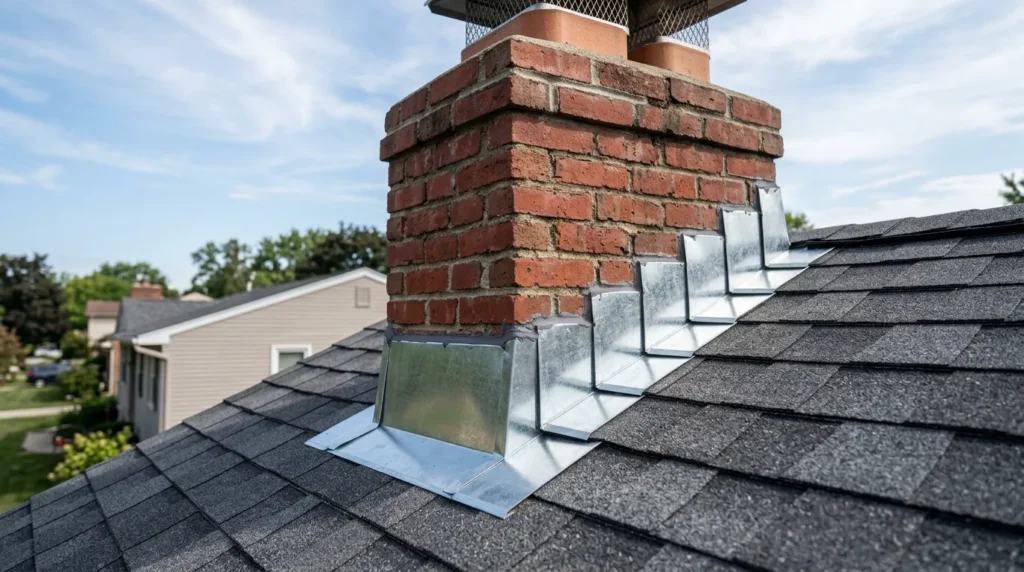
This assembly exists to solve one awkward problem. A rigid masonry stack and a flexible roof deck move at different rates through the seasons, so you cannot simply seal them together and walk away. Overlapping metal solves it, shedding water while letting the two structures shift independently.
Base flashing
Also called apron flashing, this is the piece across the downhill face. It should lap 3 to 6 inches out over the shingles and turn roughly 12 inches up the brick. Anything shorter and wind-driven rain gets under the bottom edge.
Step flashing
Up each side runs a stack of L-shaped pieces, each around 3 by 3 by 9 inches, one per shingle course. Roofers sometimes call them soakers. Each one tucks under the shingle above and over the one below, so water hits metal, then shingle, then metal again all the way down.
Here is the detail that separates a proper installation from a quick one. Some crews run a single long strip of bent metal up the side instead. It looks tidier and takes ten minutes less. It also has nowhere to move, so the first hard freeze cracks the seal at the top.
Counter flashing
Counter flashing, sometimes called cap flashing, fastens only to the masonry. A roofer bends the top edge and sets it 1 to 1.5 inches into a groove cut in a mortar joint. That groove is called a reglet. Fresh mortar or a flexible sealant locks the metal into it. It hangs down over the step pieces by at least 3 inches without touching them.
That gap matters. The roof can settle, the brickwork can expand, and the joint stays closed because the two layers slide past each other rather than tearing.
The cricket or saddle
On the uphill side, water and ice pile up behind anything wide. A cricket is a small peaked structure, framed and sheathed like the rest of the roof, that splits that flow and sends it around both sides. The International Residential Code covers this at section R1003.20. It requires a cricket on any stack wider than 30 inches across the slope, unless the masonry runs into the ridge itself.
Plenty of older chimneys simply do not have one. If yours is wide, has no saddle, and the shingles behind it stay dark for days after rain, you have found your leak.
Why it leaks: five failure points
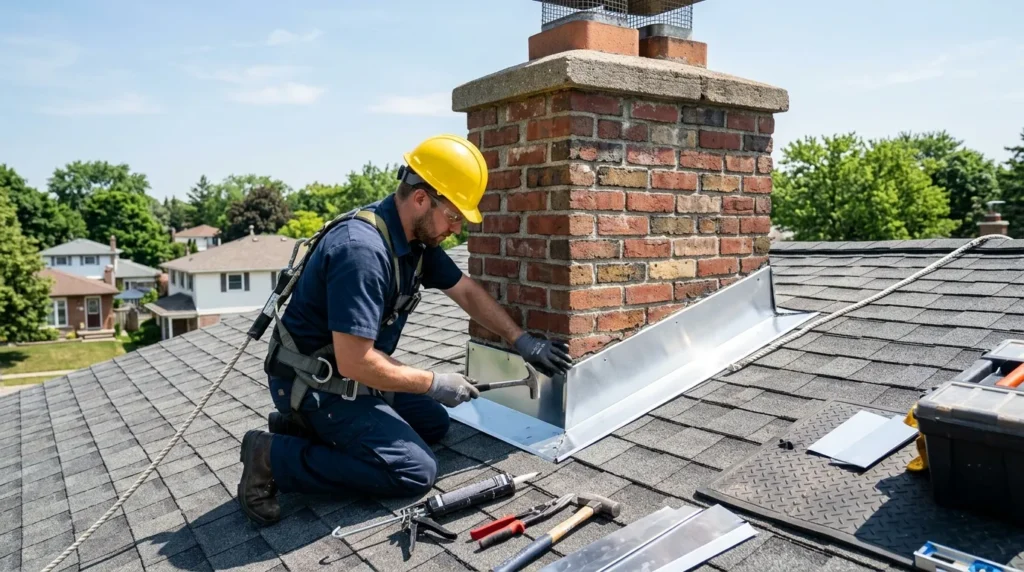
Metal rarely fails on its own. Almost every leak we see reported comes down to one of these.
- Caulk instead of a reglet. Someone smeared sealant along the top edge rather than cutting into the mortar. Sealant dries, shrinks and pulls away, usually inside three to five years.
- Galvanic corrosion. Aluminum touching copper eats itself. So does aluminum sitting against fresh mortar, which is alkaline. Mismatched metals on one stack is a slow, invisible failure.
- Tar as a repair. Roof cement smeared over old metal traps moisture underneath and hides the rust that follows.
- One-piece side flashing. No allowance for movement, so the joint opens at the top corners first.
- Missing cricket. Water and leaf litter sit behind a wide stack, saturate the shingles, then find the smallest gap in the metal.
Crumbling mortar makes all five worse. A reglet only holds if the joint around it is sound. That is why a quote on an older chimney often arrives with a tuckpointing line beside it.
Signs yours has gone
Evidence usually shows up indoors before anything looks wrong from the ground.
- Staining on the ceiling or wall on the floor below, often several feet away from the stack
- A damp, musty smell in the attic after rain, or daylight visible where the deck meets the masonry
- White mineral streaks on interior brick, which means water is soaking through the masonry
- Rust streaks, lifted corners or blobs of old sealant, visible from a neighbor’s yard with binoculars
- Shingles beside the stack that stay soaked long after the rest of the roof dries
Interior staining is the signal people act on, and it is already a late one. Our guide to how roof leaks turn into ceiling damage traces what happens between the roof deck and the drywall. Waiting a season costs far more than the metal ever would.
Repair or replace? Use the shingles to decide
Most homeowners want the cheaper fix, and sometimes that is the right answer. Ignore how bad the metal looks. Judge it on how much life the surrounding roof has left.
| Situation | Do this | Why |
| Metal is sound, sealant has cracked | Reseal and repoint the reglet | The assembly is fine, only the joint compound aged out |
| One side rusted, shingles have 8+ years left | Replace that side’s step pieces | Local repair, no reason to disturb good shingles |
| Rust across two or more faces | Full replacement | The rest will follow within a couple of winters |
| Shingles have under 5 years left | Wait and do both together | New metal has to come off again at re-roof anyway |
| Wide stack, no saddle, recurring leak | Full replacement plus a cricket | Resealing treats the symptom, not the cause |
That last row is the one people get wrong. Paying twice for a reseal on a wide stack with no saddle is money spent on a problem the metal was never going to solve.
Timing matters here, so it helps to know roughly where your roof sits in its life. Asphalt shingles typically run 15 to 30 years, metal panels a good deal longer. Our breakdown of how long a new roof lasts by material is a sensible place to check yours first.
What it costs in 2026
We checked national cost guides in August 2026 and cross-referenced three of them. The spread below reflects what US homeowners are actually being quoted, not list prices.
| Job | Typical 2026 price | Right call when |
| Reseal and re-caulk | $150 to $500 | Metal is sound, sealant has dried out |
| Step flashing, one side | $300 to $900 | Damage is local and the shingles are good |
| Counter flashing cut into new reglets | $200 to $700 | The old cap was caulked to the brick face |
| Full replacement, all four faces | $500 to $1,500 | Rust or tar repairs on multiple sides |
| Add a cricket or saddle | $400 to $1,200 | Wide stack with nothing behind it |
Most jobs land between $400 and $800. Labor is 60 to 70 percent of the bill at $50 to $125 an hour, which explains why access drives the price so hard. A two story house adds roughly 20 percent, three stories closer to 45 percent, and a steep pitch adds more again.
Material choice moves the number too. Aluminum runs $5 to $10 per linear foot and lasts 15 to 20 years. Galvanized steel sits at $6 to $10. Copper costs $15 to $30 per foot, roughly three times an aluminum assembly installed, and lasts 50 to 100 years with soldered corners. On a house you plan to keep, copper is the cheaper metal per decade. On a house you plan to sell in three years, it is not.
DIY or call a roofer
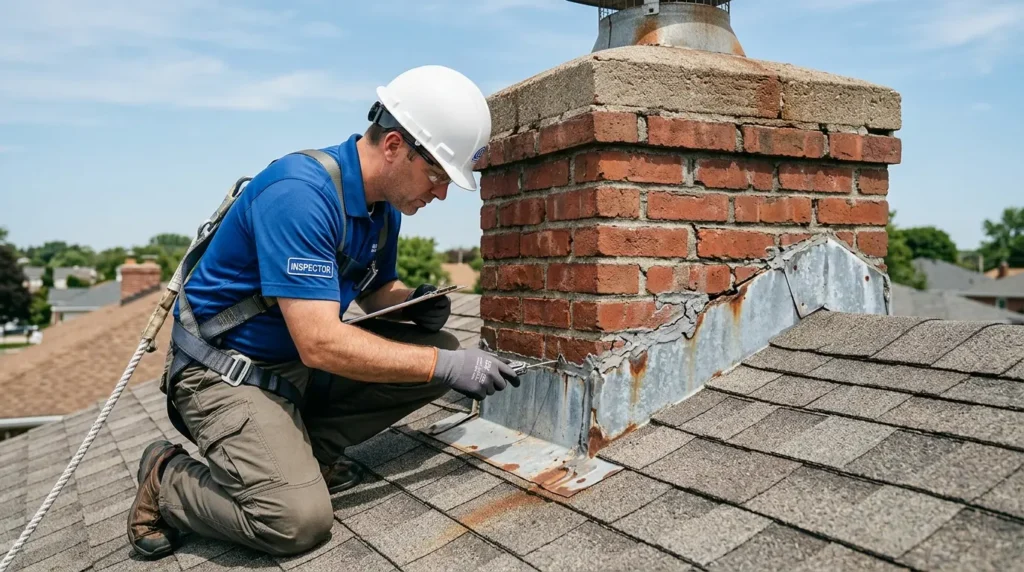
Resealing a reglet from a stable surface is within reach for a confident homeowner. Cutting new reglets, weaving step pieces into existing shingle courses and framing a saddle are not. Neither is any chimney on a steep pitch.
The safety gap between you and a contractor is wider than most people assume. According to OSHA standard 29 CFR 1926.501(b)(13), residential construction work 6 feet or more above a lower level needs fall protection. That means a guardrail, a safety net or a personal fall arrest system. Roofing carries its own requirements at (b)(10) and (b)(11).
So a crew has to anchor off before anyone steps onto the slope. You, on a ladder on a Saturday morning, have none of that. Falls remain the leading killer on construction sites, and a chimney sits at the highest point of the roof.
Call someone if any of these apply:
- Your chimney rises above a second story, or the pitch beats 6:12
- Mortar is crumbling, or the crown is cracked
- Water has already reached a ceiling
- Anyone has tarred over the metal
For storm damage, move fast. A torn seal through a wet week does more harm than the storm did. See what emergency roof repair services cover before you start ringing round.
Ask every bidder three questions. Will the counter layer go into a cut reglet or sit on the surface? What metal are you using, and does it touch any other metal? Does this chimney need a saddle? The contractor who answers all three without hedging is the one to hire.
What to do next
Start from the ground with binoculars and look for rust, lifted corners and sealant doing a job it was never meant to do. Check the attic after the next heavy rain. Then get two written quotes that state the metal, the reglet method and whether a saddle is included. Twenty minutes of looking now is what keeps a $400 repair from becoming a $4,000 ceiling.
Frequently asked questions
Expect $150 to $500 for a reseal and $500 to $1,500 for a full replacement, with most jobs settling between $400 and $800 in 2026. Adding a cricket pushes it higher.
Aluminum gives 15 to 20 years, galvanized steel a little more, and copper or lead 50 years or beyond. Sealant is the weak link and needs checking every three to five years whatever the metal is.
As a stopgap before a repair booking, yes. As the repair itself, no. Sealant carrying the load instead of a properly cut reglet is the single most common reason we see the same leak return.
Usually not for a like-for-like repair. Adding a cricket or rebuilding masonry can trigger one, and rules vary by city, so ask your building department before work starts.
Sudden storm damage is often covered. Gradual corrosion and worn sealant almost never are, since insurers treat those as deferred maintenance. Photograph the damage the day you find it.
Yes, every time. Everything is exposed, the labor is already on site, and old pieces reused under new shingles are how a brand new roof leaks in its first year.