


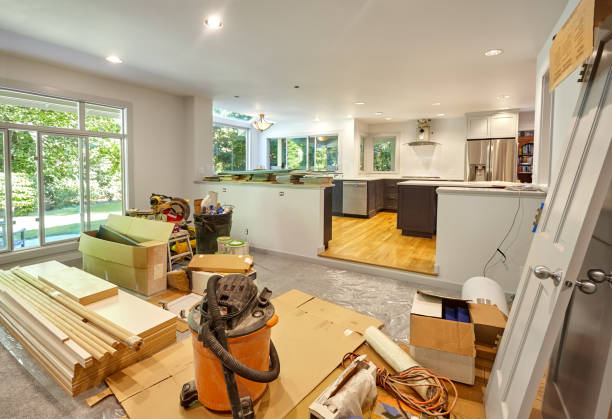
If you have ever looked up how much to budget for home maintenance, you have met the one percent rule. Set aside one percent of your home’s value every year, the guidance goes, and you will be fine. A four-hundred-thousand-dollar home means four thousand dollars a year. Tidy, memorable, and repeated on almost every personal finance site in the country.
In Dallas, it is also useless and following it can leave you badly underfunded in a way you will not discover until the bill arrives.
The rule is not wrong because math is bad. It is wrong because it was built for an average American home in an average American climate sitting on average American soil, and almost nothing about a North Texas home is average. Our ground moves. Our summers punish equipment. Our storms are their own budget line. And the single most expensive category of damage in this region is the one your insurance is least likely to pay for.
This is what home maintenance costs in Dallas, where the standard budgeting rules break, and how to think about the number in a way that reflects the house you actually own.
A quick note before the numbers: every figure here is a 2026 planning range drawn from current Dallas-Fort Worth market data, not a quote. Costs move with your specific home, its age, and the scope of the work. Use these to build a budget, then get real assessments for real decisions.
Where the budgeting rules come from, and what they miss
There are three rules of thumb in common use, and it is worth understanding all three, because their disagreement is the first clue that something is off.
- The one percent rule. Set aside one percent of your home’s value per year. On a four-hundred-thousand-dollar home, four thousand dollars.
- The square footage rule. Budget one dollar per square foot per year. A twenty-five hundred square foot home, twenty-five hundred dollars. The logic is physical rather than financial: more house means more roof, more pipe, more to maintain.
- The ten percent rule. Set aside ten percent of your monthly mortgage, taxes, and insurance.
Run those three against the same house and they will hand you three different numbers, sometimes off from one another by thousands of dollars. That alone should tell you these are rough starting points, not answers.
More useful is what every honest version of this guidance now admits. The one percent figure is calculated to a newer home in a mild climate. The moment a home ages past its first decade, or sits somewhere with real weather, the recommended range climbs to one and a half, two, even four percent of value per year. National sources now openly note that the one percent rule understates cost for older homes and harsh climates by thirty to sixty percent.
Dallas is an older-housing, harsh-climate market. The median Dallas home is around forty-seven years old. That combination puts most of the metro at the top of the range, not the bottom, before we have said a word about the thing that makes this region genuinely different.
The reason Dallas breaks the rule: the ground under your house
Every national budgeting rule share one blind spot. None of them can see your soil. And in North Texas, the soil is the story.
Much of Dallas-Fort Worth sits on expansive clay, known locally as black gumbo. It behaves less like dirt and more like a sponge with a temper. During rains, the clay absorbs water and swells, in some cases expanding by a significant fraction of its own volume. When our summers arrive and the ground bakes, it shrinks away. Wet, dry, swell, shrink, year after year. Your foundation is riding on top of all of it.
This single geological fact drives two of the largest maintenance expenses a Dallas homeowner will ever face, and neither one appears anywhere in the one percent rule.
Foundation repair
Foundation movement is close to a routine expense in North Texas rather than a rare catastrophe. Current Dallas-Fort Worth data puts a typical foundation repair somewhere in the range of roughly three thousand to eight thousand dollars, with the metro average often cited between about five thousand and seven thousand. Minor settling caught early might be a few hundred to a few thousand. But whole-house leveling or extensive pier work commonly runs fifteen thousand and up, and on larger or more complex homes it climbs well beyond that.
The pattern that matters most in that data is timing. The same problem caught at the first hairline crack might cost a few thousand dollars. Left through several Texas summers of swell and shrink, it can multiply into a five-figure structural rebuild. Deferral is not free here. It compounds.
Slab leaks
The same moving clay that cracks foundations also stresses the water lines running under your slab. Dallas sits close to the epicenter of the American slab leak problem for exactly this reason: decades of homes built on slab-on-grade foundations with pipes underneath, and ground that never stops shifting.
Current North Texas pricing puts slab leak repair broadly in the range of about fifteen hundred to eight thousand dollars, driven mostly by method. A spot repair sits at the low end. A full reroute or recipe sits at the high end. Detection alone, before any repair, typically runs a few hundred dollars. And because the underlying cause, the moving clay, does not go away, these leaks in North Texas are often recurring rather than one-and-done.
The part that turns a repair bill into a crisis: insurance usually will not cover it
Here is the detail that changes the entire calculation, and it is the one most Dallas homeowners do not learn until they are living it.
A standard homeowner’s policy is built to pay for sudden, accidental events. A tree falls on the roof. A pipe unexpectedly bursts. What it generally does not pay for is damage from the slow, gradual movement of expansive clay soil, because that is classified as a maintenance issue, not an accident. Foundation damage caused by the natural shrink and swell cycle is typically excluded.
Sit with what that means for your budget. The most expensive, most common, most quintessentially Dallas category of home damage is very often the one you pay for entirely out of pocket. There is sometimes an exception when foundation damage results directly from a separate covered peril, such as a sudden plumbing leak washing out the soil, but you cannot bank on it, and it frequently becomes a fight.
So when a national calculator tells you to set aside four thousand dollars a year, understand what it is quietly assuming: that your worst-case events are insurable. In Dallas, your most likely worst-case event may not be. That is the gap the rule cannot see, and it is the gap that wrecks budgets.
The second Dallas multiplier: the climate eats your equipment
If the soil is the first thing national rules miss, the climate is the second.
Air conditioning
A North Texas air conditioner does not get an off season. It runs long, hard hours against triple-digit heat for a large stretch of the year, and that runtime is what wears a system out. The commonly cited fifteen-to-twenty-year AC lifespan describes a unit that gets to rest. Ours often do not, which pushes real-world replacement toward the earlier end of that window.
And replacement is not cheap here. Current Dallas-Fort Worth pricing for a full system replacement generally runs from around fifty-five hundred dollars on the low end to well over thirteen thousand for larger or higher-efficiency systems, with the metro average cited around seven thousand to seventy-five hundred. Refrigerant rule changes have also pushed the standard job toward a full matched system rather than a cheaper condenser-only swap, which raises the floor on what a replacement costs. Budget for this as a when, not an if, and expect the Texas duty cycle to bring the when forward.
The roof, and the hail category all its own
North Texas sits in one of the more active hail corridors in the country, which makes roofing its own distinct budget line rather than a once-in-a-generation event. A full roof replacement in this market commonly runs from around eight thousand dollars into the twenty thousand and beyond, depending on size and material.
Roofing is more likely to involve insurance than foundation work is, since hail is a sudden covered peril on most policies. But that introduces its own recurring costs and headaches: deductibles, the wind and hail deductible many Texas policies carry separately, premium increases after claims, and the ever-present dispute over what counts as storm damage versus ordinary wear. None of that is captured in a one percent estimate either.
So what does it actually cost? A realistic Dallas range
Put the pieces together and a more honest picture emerges.
For a typical mid-life Dallas home, the realistic annual maintenance budget lands closer to one and a half to two and a half percent of the home’s value, not one percent, once you account for age, climate, and soil. On a five hundred thousand dollar home, that is roughly seven thousand five hundred to twelve thousand five hundred dollars a year, averaged over time, rather than the five thousand the simple rule suggests.
But the average is the least useful number in that sentence, because Dallas maintenance costs do not arrive smoothly. They arrive in two very different streams.
- The routine stream. The predictable, plannable annual work: HVAC servicing twice a year, gutter cleaning before fall storms, plumbing checks, water heater maintenance, filter changes, seasonal exterior prep. This is a few thousand dollars a year, it is schedulable, and it is entirely within your control.
- The big-ticket stream. Foundation movement, a slab leak, a hail roof, a compressor that dies in July. Any one of these is a single five-figure event, they are not evenly spaced, and several of them may not be insured. A quiet three-year stretch can end in a single summer that erases all of it.
That split is the entire reason the one percent rule fails people. It quotes you a smooth average for a cost structure that is anything but smooth. The homeowner who budgets four thousand dollars, has three uneventful years, and then meets a foundation problem and a dead AC in the same summer is not unlucky. They were under-budgeted from the beginning by a rule that could not see their soil or their sky.
The lever the rules ignore: deferral is the real cost driver
Read back through every expensive scenario above and notice the common thread. The foundation crack that became a rebuild. The slab leak that ran for months. The AC that died mid-summer instead of being replaced on a planned schedule. The hail damage that was not caught until it was leaking.
In nearly every case, the thing that turned a manageable cost into a large one was time. Small problems in Dallas do not stay small, because the same forces that create them, the moving clay and the punishing heat, keep working on them every single day you do not address them. Water damage becomes mold in a day or two. A minor foundation shift becomes a structural job over a few summers. A neglected AC fails at the worst possible moment, when every contractor in the metro is booked and pricing is at its peak.
This is why the most important variable in a Dallas maintenance budget is not the percentage you choose. It is whether the work is actually happening on schedule. A perfect budget with nobody minding the house still ends in expensive surprises. A modest budget attached to consistent, proactive upkeep quietly avoids most of them.
And that is precisely the piece the rules of thumb leave out. They tell you how much to save. They say nothing about the harder problem, which is making sure the right work gets done at the right time, every season, year after year, on a house that is actively trying to fall out of level.
Where a home maintenance membership in Dallas changes the math
This is the real argument for a home maintenance membership in Dallas, and it is a financial argument, not a convenience one.
The value is not that someone else holds your list. It is that consistent, scheduled, proactive maintenance attacks the exact mechanism, deferral, that turns Dallas homes into five-figure surprises. Catching a foundation shift at the first crack, finding a slab leak in week one instead of month four, replacing an aging AC on a planned timeline instead of during a July failure: each of those is the difference between the routine stream and the big-ticket stream. Every problem intercepted while it is still small is money that never leaves your account.
It is worth being precise about what that kind of membership does and does not do, because honesty is the whole point of an article like this. A home maintenance membership is not an insurance policy and not an all-you-can-eat repair plan. It does not make the cost of a new roof disappear. What it does is manage the schedule, coordinate and oversee the vendors, keep a documented history of your home’s systems, and make sure the preventable things get prevented. The repair work itself still costs what it costs. The savings come from the repairs you never have to make because something was caught in time, and from not paying rush pricing during an emergency you could have scheduled.
For a Dallas home specifically, where the biggest risks are uninsured, soil-driven, and deferral-sensitive, that preventative posture is worth more than it would be almost anywhere else in the country. The climate and the clay are exactly the conditions under which staying ahead of problems pays for itself.
How to build your own Dallas number
Whether or not you ever hand the work to anyone, here is a more honest way to budget than the one percent rule.
- Start higher than one percent. Run the one percent rule and the square footage rule, then take the higher of the two as your floor, not your target.
- Adjust up for Dallas. Add half a percent to a full percent of value for age if your home is past twenty years, and again for the climate and soil exposure every North Texas home carries. Most Dallas homes belong in the one and a half to two and a half percent band.
- Split routine from big-ticket. Keep your plannable annual maintenance in one bucket and your big-ticket reserve in another. They behave completely differently, and mixing them is how people convince themselves a quiet year means they over-saved.
- Budget the uninsured line. Assume foundation and slab movement may be on you, not your carrier. Pull your policy and confirm what is excluded before you need to know, not after.
- Spend on prevention first. A dollar spent catching a problem early is the highest-returning dollar in this entire budget, because in Dallas the alternative is not the same problem later. It is a much larger one.
The one percent rule is not malicious. It is just generic, and generic is exactly what a Dallas home is not. Between the clay and the heat and the hail and the coverage gaps, this is a market that rewards homeowners who budget for their actual conditions and punishes the ones who trust a national average. Build the number for the house you own, in the ground it sits on, under the sky it sits under. Then make sure the work gets done.
Kincaid Home Management offers a flat-rate home maintenance membership serving Dallas and Austin: one dedicated home manager, proactive maintenance scheduling built around your home’s specific systems and the Texas seasons, full vendor coordination and oversight, and zero markup on the trade work itself. For a market where the costliest problems are the ones that compound quietly, staying ahead of them is the point. Schedule a free home assessment to see what your home actually needs.